
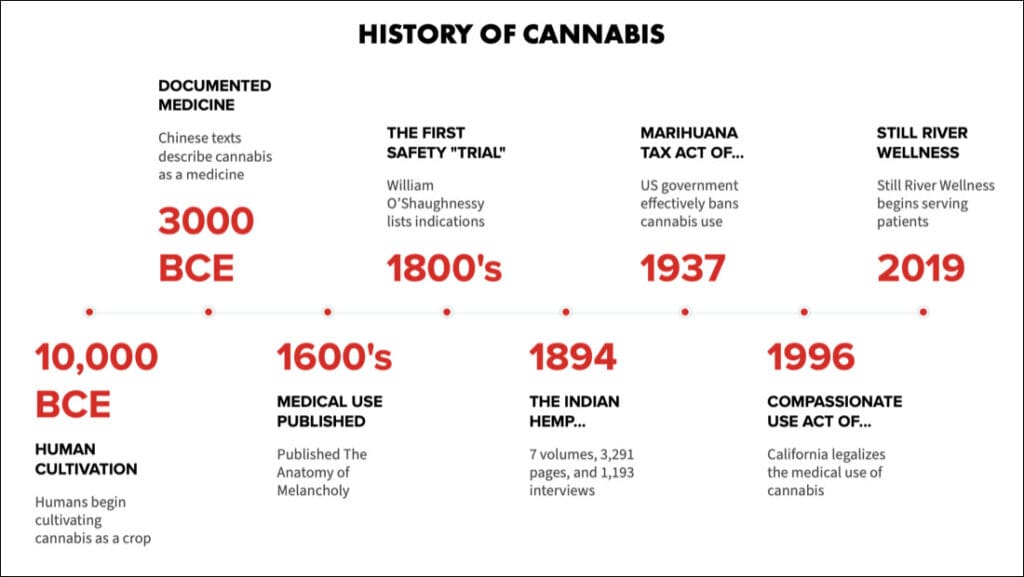
In the 1800’s, William O’Shaughnessy studied medicinal cannabis use in India, where he had access to potent crops. He not only experimented with treating various conditions but he also performed toxicity tests on animals. After determining the safety of cannabis, he began to study possible indications for cannabis use. He stated, “Of all the powerful narcotics, it is the safest to use with boldness and decision.” (O’shaugnessy WB, 1843, p. 369)1. He would then travel back to the west and introduce many of the crops he was working with.
In 1887, Raffaele Valieri began to study the use of high CBD strains. Finally, in 1894, the first report of hemp and cannabis use was published. It was called The Indian Hemp Commission and consisted of 7 volumes, 3,291 pages, and 1,193 interviews. The report concluded that it has been clearly established that the occasional use of hemp or cannabis in moderate doses may be beneficial. (Backes M., 2017, p.13)2.
It was not until 1925 when the League of Nations ratified the International Opium Convention which banned the use of cannabis except for medicinal or scientific uses. In 1928, the UK took it one step further and banned cannabis use completely. By the early 1930’s, it was banned in 48 states, despite remaining in the U.S. Pharmacopeia (USP) list of medicines.
In 1937, the U.S. Federal government passed the Marihuana Tax Act of 1937, which effectively banned cannabis use in America. At the hearing, the American Medical Association (AMA) testified to not ban the medicinal use of this plant. Unfortunately, all physician’s testimonials were ignored. In fact, the AMA continued to oppose the removal of cannabis from the USP until it was finally removed in 1942.
From 1942-1960 the only research that was done on cannabis was for the purpose of identifying it as an illegal narcotic. Finally, in 1960, scientific research on cannabis began again and it launched the modern era of cannabis. Raphael Mechoulam would then isolate THC in 1964. For the first time in history, humans had identified the compound responsible for the controversial effects of cannabis. Mechoulam postulated that our bodies must produce its own cannabinoids, called endocannabinoids.
He even predicted two of them which would later be proven to be true. The search for the receptors that THC acted on had begun, and would eventually lead to the discovery of the endocannabinoid system in 1989.
In 1996, the Compassionate Use Act of 1996 was passed in California. This was the first time a state had legalized the medicinal use of cannabis.
In 2016, the USP announced that cannabis is currently in the process of being added to the pharmacopeia.
1O’shaugnessy WB. On the Preparations of Indian Hemp, or Gunjah. Provincial Medical Journal. February 1843:360-369. https://www.ncbi.nlm.nih.gov/pmc/articles/PMC2490264.
2Backes, M., (2017). Page 13. Cannabis Pharmacy. New York, NY: Black Dog & Leventhal Publishers
There are about 120 phytocannabinoids in cannabis, however, only about 50 exist in significant quantities. Many of these exist as precursors or metabolites. For example, CBG leads to the synthesis of CBD, CBC and THC. Conversely, THC turns into CBN upon oxidation. Cannabinoids are fat soluble molecules. When they are first synthesized in the plant they are created in an acid version (i.e. THCA, CBDA, CBCA, CBGA). When heat is applied these molecules are decarboxylated and become neutral (i.e. THC, CBD, CBC, CBG). The process of decarboxylation is very important depending on what effects are desired. Cannabinoids can also be made in a propyl form (i.e. THCV, CBDV).
Each cannabinoid may offer unique effects that can be used to target specific symptoms. However, it is important to realize that no one cannabinoid is more important than another. They all offer benefits and may even work best synergistically. This is why there are various ratios of CBD:THC. Here is a list of some cannabinoids you may encounter:
There are over 200 terpenes found in cannabis, however, only about 30 exist in significant quantities. Terpenes are responsible for all flavors and aromas in cannabis. They also can provide diverse medical benefits. Terpenes influence the entire experience by working synergistically with cannabinoids; we call this the entourage effect. Terpenes can be made in various forms. The terpenoid alcohols end in -ol. The terpenes end in -ene. Here are some terpenes you may encounter:
When Raphael Mechoulam isolated THC in 1964, he sparked the search for how THC works in the body. Researchers began looking for the receptor that THC binds to. Finally, in 1989, the first cannabinoid receptor was found and named as CB1. At the time, this receptor was part of a novel body system that nobody knew existed; the endocannabinoid system.
It was hypothesized that since humans already expressed these receptors, then the body must already make its own cannabinoids, called endocannabinoids. When cannabis is consumed, cannabinoids from the plant, called phytocannabinoids are able to bind to and interact in our endocannabinoid system. In fact, Mechoulam predicted 2 endocannabinoids (anandamide and 2-AG), which would later be discovered in 1992.
Since then, scientists have discovered that the endocannabinoid system developed when animals evolved into complex organisms. The most primitive species identified to have an endocannabinoid system is the sea-squirt and hydra which evolved some 600 million years ago. This ancient body system can be found in “mammals, birds, amphibians, fish, sea urchins, leeches, and mussels” but not insects. Scientists have also identified that the endocannabinoid system expresses more receptors than any other body system. This evidence shows that the endocannabinoid system plays a vital role in basic life form functioning.
Put simply, the endocannabinoid system is our body’s balancing act. It is a direct homeostatic system, responsible for regulating basic functions that are shared across the animal kingdom.
The medical and recreational cannabis industry is rapidly expanding. One reason for this is that many people in states where cannabis is legal, such as Connecticut, are discovering more about its many benefits.
Clients come to Still River Wellness to obtain cannabis for medical and recreational purposes. While the reasons people use cannabis vary, some common reasons include improving sleep and relieving nausea, pain, and anxiety. The more people learn about the health benefits of cannabis and experience them firsthand, the more acceptance grows.
When you browse a dispensary website’s products, you’ll see mentions of cannabidiol, or CBD, and tetrahydrocannabinol, or THC. These are the two primary cannabinoids found in cannabis plants.
Understanding the difference between THC and CBD is crucial. CBD doesn’t cause a high, but it can still subtly affect the mind and body. To be federally legal in the United States, it must contain less than 0.3% THC and come from the hemp plant. On the other hand, THC is a psychoactive that produces a high.
Cannabis (marijuana) and hemp plants are varieties of the Cannabis sativa species, which is part of the Cannabaceae family. The plants each contain THC and CBD to varying degrees. Marijuana plants are bred to contain higher levels of THC, while hemp plants are bred for CBD and other hemp-derived products, such as paper and bedding.
There are three primary types of cannabis strains: sativa, indica, and hybrid. Sativa and indica refer to the botanical classifications and not the effects. Hybrid products, a combination of the two, can have a balance between sativa and indica or lean more toward one than the other.
In the marijuana world, many people label sativa and indica as having generalized effects, with sativa being referred to as uplifting and stimulating and indica as relaxing and sedating. However, the actual effects a person experiences can vary dramatically, primarily based on the corresponding levels of CBD and THC, as well as the terpenes that provide the flavor and aroma.
Don’t overdo dosing, especially if you’re new to ingesting marijuana. Many people make the mistake of taking a dose, only to take more not long after, believing they didn’t take enough to produce an effect. However, it can take anywhere from minutes to hours for the effects to kick in. Increase your dose gradually, if at all. Otherwise, you may end up ingesting too much and experiencing negative effects, such as paranoia and hallucinations.
Still River Wellness offers a wide range of products on our website, including pre-rolls, edibles, vaporizers, and flower. Have questions about which might be best for you? Feel free to contact one of our team members for assistance.
Sources:
O’shaugnessy WB. On the Preparations of Indian Hemp, or Gunjah. Provincial Medical Journal. February 1843:360-369. https://www.ncbi.nlm.nih.gov/pmc/articles/PMC2490264.
Backes, M., (2017). Page 13. Cannabis Pharmacy. New York, NY: Black Dog & Leventhal Publishers
You are not allowed to view this website.